Service Business SEO Case Study: 26.7K Impressions and 1.2K Clicks in 90 Days
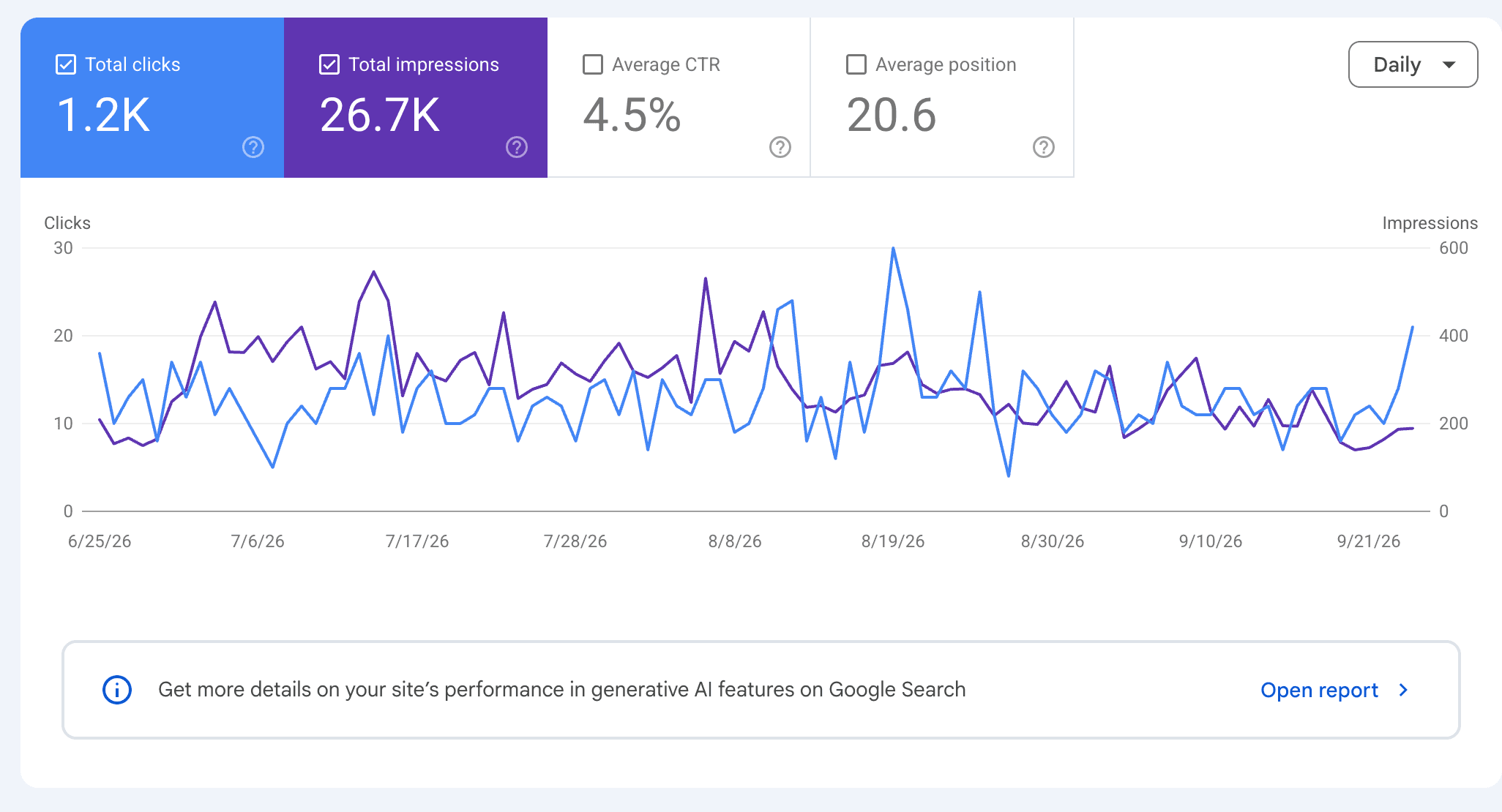
Service business SEO case study: restructuring service pages, entity schema and topic clusters produced 1.2K clicks, 26.7K impressions, a 4.5% CTR and an average position of 20.6 — verified in Google Search Console.
- Industry
- Service-Oriented Business (Professional Services)
- Engagement
- 25 Jun – 21 Sep 2026
Project Overview
A service business relying on referrals wanted a predictable inbound channel. Its website ranked for a handful of brand terms and nothing else: service pages were thin and interchangeable, blog posts were published without a structure, and Google had no clear entity to associate with the business. Over 90 days we rebuilt the site's information architecture around the way clients actually search, gave every service a dedicated optimised page, and used topic clusters and schema to make the offering explicit to search engines.
The Challenge
One page was trying to serve five different services, so it could not rank well for any of them. Location and entity signals were missing, structured data was absent, and the blog operated as a silo with no links to the pages that generate enquiries. Most queries sat between positions 11 and 20 — visible, but rarely clicked — and the site's average CTR suffered as a result.
- Multiple services targeted by a single generic page, splitting relevance.
- No Service or LocalBusiness schema — no rich results or clear entity signals.
- Blog content published in silos with zero internal links to enquiry pages.
- Most non-brand queries sitting on page two (positions 11–20).
- Template-heavy pages with poor mobile Core Web Vitals.
- Inconsistent business details across the site and third-party directories.
The Solution
We split the offering into one dedicated, fully optimised page per service, each with its own search-intent-led copy, FAQ section and Service schema. A hub page and topic cluster structure then connected informational articles to those money pages, so every post passed internal-link equity where it converts. Entity signals were tightened — consistent business details, Organization and LocalBusiness markup, and a clear heading hierarchy — while the template was slimmed down to fix mobile performance.
How the Work Was Executed
- 01
Intent & Gap Audit
Mapped every service against real search demand, identified which queries belonged on which page, and found the gaps competitors were already winning.
- 02
Information Architecture
Rebuilt the navigation and URL structure: one page per service, a supporting hub, and a cluster model that connects articles to enquiry pages.
- 03
Service Pages & Entity Schema
Wrote intent-led copy for each service, added FAQs and Service, FAQPage and LocalBusiness JSON-LD, and normalised business details sitewide.
- 04
Content Clusters & Measurement
Published supporting articles targeting problem-aware queries, internally linked them to service pages, and tracked position movement weekly in GSC.
What Was Implemented
- One dedicated, fully optimised landing page per service
- Service, FAQPage and LocalBusiness structured data sitewide
- Topic cluster hub with internal links from articles to service pages
- Unique title tags and meta descriptions aligned to search intent
- Consistent business details (NAP) across site and directories
- Mobile performance fixes: deferred scripts, compressed assets, tighter template
- Clear H1/H2 hierarchy and semantic HTML on every service page
- Weekly GSC tracking of queries, average position and CTR by page group
The Results
Between 25 June and 21 September 2026 the site earned 1.2K clicks from 26.7K impressions at a 4.5% average CTR, holding an average position of 20.6 across a broad query set that includes a large share of early-stage informational searches. The commercial pages now carry unique titles, schema and internal-link equity, and the mid-tail queries previously parked on page two have a clear route to page one. Impressions are the leading indicator here: the site is being surfaced for far more relevant queries than before, and clicks follow as those positions firm up.
1.2K clicks · 26.7K impressions · 4.5% CTR · average position 20.6 — verified in Google Search Console.
Source: Google Search Console, Performance report, 25 Jun 2026 – 21 Sep 2026 (all devices).
Skills & Tools Applied
Want numbers like these for your site?
Send me your URL and I'll review your technical SEO, Core Web Vitals and search visibility — with a prioritised action list.